Wednesday, November 22, 2017

Digitizing Hervor - Part 2: Approaches & Methods

In the last post, I introduced the Digital Hervararkviða, the labor of love I have undertaken in my quest to come to a better understanding of the ancient Germanic world, it's languages and literature. In this post, I'll talk a bit more about the methods I'm using to create the digital edition of the poem, and why what I'm doing isn't just redundant with previous critical texts of the poem and of Hervarar's saga.

TEI Encoding

First, I'll need to explain a little about TEI encoding. The Text Encoding Initiative (TEI) is "a consortium which collectively develops and maintains a standard for the representation of texts in digital form." Essentially, TEI encoding is a set of standards for taking a text--say the poems of Emily Dickinson or a sixteenth-century Polish fencing manual--and turning them into a robust, searchable XML document which can then be displayed in a number of different formats, inserted into a database in order to perform corpus linguistics analysis, and etc. Basically, once the text is in this standardized XML form, you can do anything with it.

[If you're reading this on a web browser there's a pretty good chance you have an idea of what XML is, but if you don't, you can go and educate yourself here.]

The Menota Project

Now, there are a lot of TEI encoding projects out there (including some which are pretty useful for medievalists and classicists everywhere, like the Perseus project), but the one that is important to this project is the Medieval Nordic Text Archive (Menota). Menota is basically a network of institutions working to do for the Scandinavian languages (mostly Old Icelandic and Old Norwegian at this point, though there are some Old Swedish texts as well) what the Perseus project has done for Greek and Latin. Menota has laid out a process as well as a series of standards for encoding these Old Norse manuscripts at three different levels of text representation:

Facsimile: At this level, the manuscript is transcribed character by character, line by line, retaining all abbreviations and allographic variations found in the original text. This is the closest level of reading possible short of actually handling the manuscript.

Diplomatic: Certain allographic variants are normalized (for instance, the rotunda "long s" is frequently changed to the modern "short" s. Abbreviations are also expanded, and the expansions usually italicized.

Normalized: Spelling and word forms are standardized to conform to grammars and dictionaries for the language in question. For our purposes, this means altering the words to match what you'd find in a dictionary like Zoega's, or a grammar like A New Introduction to Old Norse. This level is useful for newer students of the language who might be confused by the inconsistencies in orthography and even morphology which might be found in an unedited manuscript. It is also the level at which most critical editions tend to be produced. Old English texts, for instance, tend to be normalized to a particular West Saxon literary style, which can often lead to the misleading impression that writing in Anglo-Saxon England conformed to a fairly homogeneous standard.

How normalized spelling is determined for a dead language is a subject for another post, but for now it's enough to know that this...
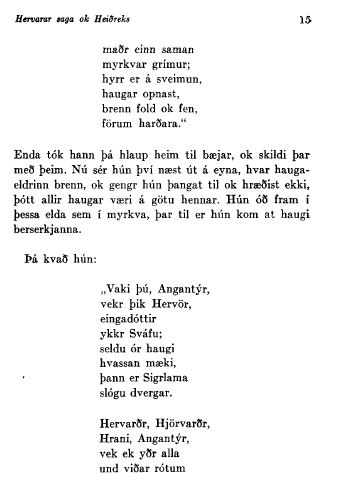
The beginning of Hervararkviða from G. Turville-Petre's critical edition of Hervara saga.
...is not the same as this:

The same passage from 74r of the Hauksbok manuscript
The Birth of the Digital Hervararkviða 

In a way, that gap between the manuscript and normalized editions is what birthed this entire project. I knew I wanted to do something with the Hervararkviða or with Eddic poetry in general; I knew that pretty much all of the Eddic poetry out there already had at least one good critical edition along with multiple translations (maybe not as many translations as Beowulf, but the Poetic Edda has been done lots of times). It was while chatting with one of my professors at Signum, Prof. Paul Peterson, that I stumbled upon the idea for this project. Paul suggested a TEI text and, knowing I was interested in the Hervararkviða, pointed out that high resolution photographs of the entire Hauksbok manuscript were available online. 

Curious, I began trying to read the manuscript, very quickly realizing I only thought I knew how to read Old Norse. This manuscript was full of strange letters I did not recognize, spelling variations I had never seen, and more abbreviations I had ever seen in a single text (and I work with the US Government, where abbreviations are our stock and trade). I had always known that the normalized text was not quite the text I was encountering in a textbook or reader, but until I actually studied the manuscript for myself I had no appreciation for just how wide that gap could be. 

Bridging that gap, then, for other students of Old Norse, is one of the primary goals of the project. And the Menota Project's encoding standards allow us to do that by encoding each word with readings on all three representation levels.

XML in Action

Let's take the word berserkjanna, the genitive plural of berserkr. This word appears in the prose introduction to the Hervararkviða. In the manuscript, it's actually written as: 


Which in my facsimile I have transcribed as:

I have to render the transcription as an image for this blog post, because otherwise there are characters which won't show up unless you have certain medieval fonts installed. You'll notice that there's a little squiggly line over the b. This is an abbreviation for er. The funky-looking "f" is really a long s. You'll note there's an i here instead of a j, and a bar over the n to indicate a second n has been omitted. I'll talk in greater detail about Old Norse abbreviations in a future post, but it's important to understand that it was fairly standard to use this many abbreviations in a word.

On a diplomatic level, we would render this word: berserkianna. The s has been standardized, and the abbreviations have been expanded and italicized. 

In our normalized edition this word would be rendered (as Turville-Petre in fact does): berserkjanna. Note the i has been changed to a j here, because that's in keeping with the way you'd find the form listed in a grammar or dictionary.

A properly formed Menota XML document allows us to encode all three levels in a single word, like so, with the <me:facs> tag corresponding to the facsimile-level reading, and so on:

<w>
   <choice>
    <me:facs>b<am>&er;</am>&slong;erkian<am>&bar;</am>a</me:facs>
    <me:dipl>b<ex>er</ex>serkian<ex>n</ex>a</me:dipl>
  <me:norm>berserkjanna</me:norm>
   </choice>
</w>

Of course to do this, it means you're encoding every single word three times. Which is what I've done. For the entire poem. Yep, it took me a while. And I'm still not done.

Once it's all in there, though, you can use an XSLT stylesheet (a topic for another post) to render any single reading level. That means that every Menota XML document has the potential to contain readings on all three levels, not to mention a wide variety of information about each word--lexical citation forms, base forms, morphology, syntax, the type of word (noun, proper name, verb, etc.). Although this kind of secondary information wouldn't typically be displayed by your style sheet, it might be accessible via a specialized web page or app. So in the final edition of the Digital Hervararkviða, the student should be able to mouse over a word and see its case/number (for nouns) or tense/mood/number (for verbs), as well as the lexical citation form that they can look up in the dictionary. The student should also be able to toggle between the facs/dip/normalized views at will and compare them to photographs of the text. And of course, since all of this information is being stored in XML, it has the potential to be used in a database for performing corpus-level analytics.

In the next post, I'll talk about the process used for creating the manuscript facsimile. We'll jump into the deep end of the pool of Old Norse paleography, and I'll recount the roadblocks and frustrations I encountered as I attempted to figure out just how people decided how things should be put down on paper more than 600 years ago.

Tuesday, November 21, 2017

Digitizing Hervor - Part 1: The Project

Related image
"Wake thou, Angantyr!
Wakes you Hervor,
Svafa's offspring,
Your only daughter;
The keen-edged blade
From the barrow give me,
The sword dwarves smithied
For Sigrlami."

This is the first of a series of posts I hope to do about a project I've spent the last 7 weeks working on, and which I expect will occupy my attention to some extent all the way through the summer of 2018.

The Project

I am creating a digital edition of the Hervararkviða, also known as Hervor's Incantation or The Waking of Angantyr. This edition will be based on the version found in the Hauksbók manuscript and will include a Manuscript Facsimile, Diplomatic, Normalized Old Norse, and Modern English translation, along with textual apparatus and a short commentary. The Digital Hervararkviða is intended to be a student's edition specifically for students of Old Norse and Germanic Philology.

The Hervararwhat?

The Hervararkviða is an Old Norse poem, written in an Eddic verse form called fornyrðislag, literally "ancient-sayings-law." It tells the story of the shield-maiden Hervor's quest to wake the ghost of her famous berserker father Angantyr (and his eleven brothers) and bully him into handing over her family's cursed sword, Tyrfingr, a weapon so bloodthirsty that once drawn it cannot be sheathed again without shedding blood, even if it is the blood of a kinsman. Hervor succeeds in acquiring the sword, even though she knows it will prove the destruction of her descendants. Hervor's story is part of a larger saga known as Hervarar saga ok Heiðreks or The Saga of King Heidrek the Wise, written down in the late 13th or early 14th century, but clearly compiled from a number of much older stories.

So why are you doing this?

In the Fall of 2014 I began working on my MA from Signum University. Over time, my interest in general medieval literature has developed into a particular interest in the discipline of Germanic Philology and the languages and stories of the ancient northern world (although I remain interested in a wide variety of Indo-European studies). A project like the Digital Hervararkviða ticks a lot of boxes for my final thesis project: it's a good way to showcase my strengths as both a technology professional and a philologist. It's also a useful proof-case for the application of the digital humanities to what has traditionally been regarded as a pretty "dusty" field. In that way, it's a neat microcosm of Signum's mission statement.

Right, right. But why are you really doing this?

Someone (I do not remember whom) once said, "I read because I want to speak with the dead." That's an apt way to sum up my relationship with old texts, and particularly poetry like the Hervararkviða or Beowulf. The almost-alien quality of the medieval script, the arresting strangeness of the alliterative verse, the sonorous music of the language--all of these things take me back (as surely they must have done for 13th century Icelanders) to a different world of larger-than-life characters.

And it's hard to imagine anyone more larger-than-life than Hervor (who, as it happens, also wants to speak with the dead). Stunningly beautiful, as a young woman she cares more for swordplay and horsemanship than for weaving or embroidery, and takes out her teenage angst by essentially heading for the woods and living the life of a bandit. After she is goaded about her parentage by a slave, she decides to prove she is actually the daughter of the famous berserker Angantyr by going and claiming the family's cursed sword from her father's ghost. This she eventually manages to do, as the poem retells, after Angantyr's repeated attempts to terrify her fail. But it turns out Angantyr has a good reason for denying his daughter the sword: It is cursed, and if she takes it it will be the ruin of all her family. Hervor acknowledges this, but says she doesn't care. As so often is the case in these stories, the prophecy comes true. By her pride, Hervor secures her reputation, but dooms her future heirs.

Hervor (like Eowyn or Turin Turambar) is the sort of proud, doomed character with whom I fall in love rather easily, and the Hervararkviða--which I first encountered during Signum's Introduction to Old Norse--is one of my favorite Old Norse poems.

But do we really need another edition?

That's a good question. After all, a very good critical edition of the whole of Hervarar saga (a synthesis of the three main manuscript sources) is freely available from The Viking Society for Northern Research, as is a facing translation and commentary by Christopher Tolkien. I'll answer this question in my next post, when I introduce the methodology I am using in this project, and what will make The Digital Hervararkviða so different from previous editions of the poem.

Thursday, November 16, 2017

Whole and Holy


On the Etymology of ‘Whole’ and ‘Holy’

Although the words whole and holy sound similar in Modern English, differences in spelling and semantics mean that many speakers may not immediately recognize a relationship between the two. They are still less likely to notice relationships between hail, health, hallow, and heal. A quick glance at an etymological dictionary shows that this family of words are all descended from Old English hal and halig, which both ultimately derive from a related Proto-Germanic root.[1] (“holy”; “whole”) Such etymologies are easy to summarize, but a summary alone does not really tell the story of the words, or explain the origin of such divergent definitions as “free from disease,” “entire,” and “sanctified, set apart for religious purposes.”

Looking at other modern Germanic languages shows that the aural similarities between these words is no mere coincidence. In Modern German their relationship is even clearer: it has heil [both salutary as in Modern English hail and meaning “whole, unhurt, in one piece”] and heilig [“holy, sacred thing; saint”]. Dutch has heil [“prosperity, salvation”] and heel [“whole, all, entire”]. Norwegian has heil [“whole, healthy”] and hellig [“holy”], while Swedish has hel [“whole”] and helig [“holy”]. (“holy”; “whole”)

The consistency of these words across the family of modern Germanic languages suggests that at some point in the past, a close relationship existed in the minds of Germanic speakers between the ideas of “wholeness” and “holiness”—or at least between whole things and holy things. Similarly, the fact that this relationship survives in both West Germanic (Mod. English, Dutch, German) and North Germanic (Norwegian, Danish, Swedish) suggests a semantic unity that existed before the two language families diverged. To test this hypothesis, we can trace the words whole and holy back to their use in earlier forms of the language to determine when the divergence of meaning occurred—and whether that divergence is due to some change in the language, or to the shifting relationship of Germanic speakers with religious concepts.

Removing the 15th Century unetymological spelling initial h(w)- as wh- (as in hwæt > what) in whole brings us to Middle English hal[2], hol, or hool, [“sound, healthy, intact” or “whole, undivided”]. (“whole”) This in turn is descended directly from Old English hal, the sense of which can be seen in the promise of the Danish coast guard to Beowulf: “…swylcum gefiþe bið / þæt þone hilderaes hal gedigeð.” (Beowulf line 300) This word was an important component in common Old English greetings; Beowulf, meeting Hrothgar, wishes him “Wæs þu, Hroðgar, hal.” (Beowulf line 407) Its use as a salutation is analogous to archaic Modern English hail, Modern German heil, and Latin salve.

Similarly, Modern English holy < Middle English holi, hali < Old English halig. (“holy”) Unlike the Modern English form of the word, halig is used exclusively as an adjective, describing something which is holy or sacred in a religious sense (usually the Christian God). Thus Hrothgar, in his speculation on the reason for Beowulf’s coming to Heorot, says, “…hine halig god / for arstafum  us onsende…” (Beowulf line 381) One might also think of one of the many appellations of God in Cædmon’s Hymn, halig scieppend. (Fulk and Pope 4)

A look these words in cognate Germanic dialects helps to narrow the semantic gap between them. Otfrid, in the Old High German Evangelienbuch, uses the OHG heil (cognate with hal) both as a salutation (“Heil thu”, quadun sie, “Krist! / thu therero liuto kuning bist”) (Otfrid 1 I:113) as well as to render salvatio (“Nu will ih scríban unser héil”). (Otfrid 4 XXII:27) In Old Norse, this word appears as the feminine noun heill, which can be translated as “good luck” but also “omen.” (“*xailaz I”) In fact, hal and its cognates seem particularly associated with omens: OE hel and OGH heil are both used to translate Latin omen, augurium and auspicium. (Green 17)

According to Tacitus, the religion of the Germani centered closely around the practice of divination—consulting oracles to know the will of the gods. Such ceremonies seem to have usually been accompanied by sacrifices (the ON term for consulting an oracle is fella blótspán; the element blót- specifically suggests a blood sacrifice), and would hopefully result in a favorable omen. It seems likely, then, that hal originated as a word referring to the oracular practice, and later to general welfare or good luck. A similar sort of shift has occurred between Latin auspicium [“augury”] and Modern English auspicious [“of good omen, indicating future success”].

The Old English adjectival endings -eg and -ig are descended from the Proto-Germanic adjectival ending, used to form adjectives from nouns or verbs and communicating the sense “having the qualities of.” (“-y, suffix1”) Halig and its cognates could thus be applied to describe those who possess and give hal, the material goods associated with the oracular ceremony used to seek hal, as well as the ceremony itself.

Green suggests that OE hal and its cognates originally referred to the good fortune which came from, or could be withheld by, the gods, and which was sought in the religious practice of consulting the oracle through sacrifice.[3] He further argues that the nature of the good fortune desired by the Germanic peoples may be seen in the meanings which hal’s modern descendants have retained: whole, heal, health.

Heil therefore came from the gods, directly or through an intermediary, whilst heilag could be applied to the originator, the transmitter or the recipient of this gift from above… Like the Christian sanctus[4], the Germanic term heilag denoted a quality of divine origin, but unlike sanctus the gift it presented was not to be enjoyed in the afterlife, but in the here and now. (Green 19-20)

But it is unnecessary to limit the concept of hal in this way. Allowing that hal is the gift of the gods, it does not follow that its application to the intangible, or for that matter the afterlife, was a strictly Christian innovation. When Wulfila renders the “teaching which brings salvation” as laiseinai hailai, does it really represent a new stage in the development of hal, or might he be using a concept which would have been familiar to his audience when he translates salvation as a kind of spiritual good fortune? (Wulfila An Titus 1:9) It is safer to assume a close connection in the mind of the early Germanic speakers between the natural and supernatural, than to insist they had no idea of blessing beyond their physical needs.

In Modern English, the words holy and whole are separated not only by meaning, but by context: one belongs to the realm of the spiritual, the other to the physical.[5] But by tracing these words back to an earlier form of the language, we see that this is a relatively recent divide. For the speakers of early Germanic, health and success—”good fortune”—was inextricable from their interaction with the divine, a relationship preserved by those languages’ earliest Christian writers. The gap between the two concepts widened over the course of centuries, as the ideas of physical well-being and religious practice became less and less associated with one another.

Works Cited
“-y, suffix1.” OED Online. Oxford University Press, June 2017. Web. 9 September 2017.Fulk, Robert Dennis., and John C. Pope. Eight Old English poems. New York, W. W. Norton, 2001.

Green, Dennis Howard. Language and History in the Early Germanic World. Cambridge University Press, 1998.

“hale, adj. and adv.” OED Online. Oxford University Press, June 2017. Web. 24 September 2017.

“holy, adj. and n.” OED Online. Oxford University Press, June 2017. Web. 9 September 2017.

Otfrid von Weißenburg. Das Evangelienbuch. http://titus.uni-frankfurt.de/texte/etcs/germ/ahd/otfrid/otfri.htm. Accessed 9 September 2017.

“Sanctus”. Valpy, F. E. J. An Etymological Dictionary of the Latin Language. London, Printed by A.J. Valpy, sold by Baldwin and Co., 1828.

“whole, adj. (and int.), n., and adv.” OED Online. Oxford University Press, June 2017. Web. 9 September 2017.

“*xailagaz”. Orel, Vladimir E. A Handbook of Germanic Etymology. Leiden, Brill, 2003.

“*xailaz I”. Orel, Vladimir E. A Handbook of Germanic Etymology. Leiden, Brill, 2003.

“*xailaz II”. Orel, Vladimir E. A Handbook of Germanic Etymology. Leiden, Brill, 2003.


[1] whole descends from the Proto-Germanic adjective *xailaz, while holy descends from the Proto-Germanic noun *xailaz by way of its adjectival form *xailagaz. (“xailaz I”; “xailaz II”; “xailagaz”) Throughout this post, I have chosen to deal with these words in their attested forms in the various dialects of Old Germanic.
[2] Modern English hale, now seldom used except as an archaism, is a parallel to the more common whole, and developed in a Northern dialect from Middle English hal. (“hale”)
[3] These attested forms, of course, only survive in a Christian context.
[4] Green is here using sanctus to refer to the Christian concept of holiness. But sanctus’ own etymology might tell an interesting story, since it is derived from the verb sancio “I decree, I consecrate a law by the offering of a victim.” (“Sanctus”) This suggests an association (in fact well-attested) between the legal and religious practices of pre-Christian Latin speakers, without insisting those speakers could only conceive of holiness as a matter of jurisprudence.
[5] The religious usage “to make whole” may provide an interesting example of the reunification of these concepts: it originates with early English translations of the Bible, in passages referring to physical healing. It came very quickly to refer by analogy to spiritual salvation, so that Wycliffe could write, “God wolde þat proude men and leprous heretikes wolden wel confesse þe feiþ, and þan shulden þei be hool.” (“whole”)

Monday, June 5, 2017

How do I really feel about Beowulf?

Beowulf came to me, not as lightning out of a clear sky, but as the treasure-laden funeral ship of Scyld: gray prow and mast and ropes looming up out of the mist, the guilt edges of the golden sail billowing just beyond sight.

When I first read the poem, as a young lad, I could only see the faintest outline of its dragon-headed prow. It was a story full of monsters, one which happened "in days of yore" in a land and culture so far from my own that it may as well have been on another planet. But there was something familiar about it even then, though I did not know what, and discovering the poem was like remembering something that I had forgotten.

As I grew older and read the poem again and again the outline of the ship became clearer, and I even began to mark the significance of the strange carvings on its ring-whorled prow. Or rather, I began to attempt to infuse them with significance of my own, for I knew that they must mean something, so I tried to give them meanings which they could not hold. The ship was fixed, like an island in the sea; it would endure, it was I who was falling away into the mist.

Then I first began to see where other men and women had also struggled to draw the ship into their own harbor, catching it with great hooks of iron and trying to drag it out of the mist and re-purpose it for their own use. "This is a fine ship," they said, "and it is a great shame that it should hold only the bones of a dead man. We will draw it into our harbor and make it useful again, to carry more practical cargo or make raids upon our enemies.." But it could not be done. For when those men had drawn their catch to shore they found they had not captured a living vessel at all, but only dead flotsman and jetsam - unsound vessels which could not keep out the sea.

Abandoning this plan, I began to chase the ship itself, determined that if I could not bring it into my own harbor, I would instead cling to some rope or spar, and let the ship carry me where it would. It was only when I learned to read Anglo-Saxon that the whole outline of the ship became clear to me for the very first time: tall, icy, ring-whorled, the beds of ancient kings and heroes laid out upon biers of gold under ancient standards, gray ropes trailing through the mists. I can see only the faintest glitter of that treasure now, and yet I no longer wish to fill my pockets with rings and gems to take home and strew among my pet causes and soapboxes. I cling to the side, damp with mist and the spray of the sea-foam, and hope that Scyld's ship will take me back, by the straight road, to Those who sent him.

Saturday, December 3, 2016

Tempered in Blood

Beowulf, lines 2669-2693.

Æfter ðām wordum    wyrm yrre cwōm,
atol inwitgæst    ōðre sīðe
fȳrwylmum fāh    fīonda nīos()an,
lāðra manna.    Līġ ȳðum fōr;
born bord wið rond.    Byrne ne meahte
ġeongum gārwigan    ġēoce ġefremman,
ac se maga ġeonga    under his mǣġes scyld
elne ġeēode,    þā his āgen (wæs)
glēdum forgrunden.    Þā ġēn gūðcyning
m(ōd) ġemunde,    mæġenstrenġo slōh
hildebille,    þæt hyt on heafolan stōd
nīþe ġenȳded;    Næġling forbærst,
ġeswāc æt sæċċe    sweord Bīowulfes
gomol ond grǣġmǣl.    Him þæt ġifeðe ne wæs
þæt him īrenna    ecge mihton
helpan æt hilde;    wæs sīo hond tō strong,
sē ðe mēċa ġehwane    mīne ġefrǣġe
swenġe ofersōhte    þonne hē tō sæċċe bær
wǣpen wundum heard;    næs him wihte ðē sēl.
  Þā wæs þēodsceaða    þriddan sīðe,
frēcne fȳrdraca    fǣhða ġemyndiġ,
rǣsde on ðone rōfan,    þā him rūm āġeald,
hāt ond heaðogrim,    heals ealne ymbefēng
biteran bānum.    Hē ġeblōdegod wearð
sāwuldrīore;    swāt ȳðum wēoll.

[After those words the worm angry came,
Terrible spiteful visitor, for the second time
With fire-surges adorned, enemies to seek out,
Hostile ones of men. Flame advanced in waves;
Burned shield up to the boss. Byrnie might not
To the young spear-warrior help furnish,
But the young man under his kinsman’s shield
Bravely went to, when his own was
By flames destroyed. Then again the war-king
Courage summoned, in great strength struck
With battle-sword, that it on the head stuck
By violence impelled; Næġling shattered,
Beowulf’s sword failed at combat,
Ancient and grey-marked. That never was to him granted
That iron’s edge might him
Help at battle; his hand was too strong,
Which of swords every, as I have heard say,
With blow over strained, when he to fight bore
Weapon by wounds hardened; it was not any better for him.
Then was the ravager of people for a third time,
Terrible fire-drake of feuds mindful,
Rushed on that famous one, when to him opportunity was offered,
Hot and battle-fierce, the neck whole enclosed
With sharp tusks. He made bloody
With life-blood; the blood welled out in waves.]

Throughout the poem Beowulf seems to have had little use for swords: he does not wear one to the battle with Grendel; Hrunting fails him when he fights with Grendel’s mother, and the sword he eventually uses to kill her (which is the “work of giants”) melts away after having been used to decapitate Grendel; in the slaying of Dayraven, a deed of which Beowulf is sufficiently proud to mention it in his final speech to his retainers, Beowulf does not slay him with a sword, but rather crushes his “bone-house” with a mighty bear-hug.


This preference for unarmed combat is now at least partially explained by the fact that Beowulf is so strong that weapons shatter when he strikes, even when he bears a weapon “hardened in wounds.” This cryptic reference may refer to practices or beliefs in ancient Scandinavia surrounding the tempering of weapons in blood (blood and urine are both traditional fluids used in the tempering process) to harden the steel as well as render it less likely to shatter on impact; in other words, the normal measures taken to prevent steel from shattering are no good for Beowulf, thus the “næs him wihte ðē sēl.” If the speculations about the origin of Beowulf himself as a “bear’s son” figure are true, this may be the echo of a comical episode from folklore in which bear’s son is so strong he shatters every weapon he holds. In that case, the poet seems to have appropriated it here for dramatic effect.

Treacherous Hate and Eternal Rewards

Beowulf, lines 1192-1214.

Him wæs ful boren,    ond frēondlaþu
wordum bwæġned,    ond wunden gold
ēstum ġeēawed,    earmrēade twā,
hræġl ond hringas,    healsbēaga mǣst
þāra þe iċ on foldan    ġfræġen hæbbe.
Nǣniġne iċ under sweġle    sēlran hȳrde
hordmāððụm hæleþa    syþðan Hāma ætwæġ
tō þǣre byrhtan byriġ    Brōsinga mene,
siġle ond sinċfæt –    searonīðas flēah
Eormenrīċes,    ġeċēas ēċne rǣd.
Þone hrinġ hæfde    Hiġelāc Ġēata,
nefa Swertinges    nȳhstan sīðe,
siðþan hē for wlenċo    wēan āhsode,
fǣhðe tō Frȳsum.    Hē þā frætwe wæġ,
eorclanstānas    ofer ȳða ful,
rīċe þēoden;    hē under rande ġecranc.
Ġehwearf þā in Francna fæþm    feorh cyninges,
brēostġewǣdu,    ond se bēah somod.
Wyrsan wīġfrecan    wæl rēafeden
æfter gūðsceare;    Ġēata lēode
hrēawīċ hēoldon.    Heal swēġe onfēng.

[To him was the cup born and friendly invitation
With words offered, and twisted gold
With good will presented, arm-ornaments twain,
Garment and rings, of neck rings greatest
Of those that I in earth have heard.
I under heaven heard of no better
Treasure of heroes, since Hama carried away
To that fair stronghold the necklace of the Brosings,
Jewel and fine setting – fleeing the treacherous hate
Of Eormenric, chose eternal rewards.
This collar had Hygelac of the Geats
Grandson of Swerting, at [his] last expedition,
When he under the standard defended treasure,
Guarding the spoil of the slain; fate bore him off,
When he for pride looked for woe,
Assault on Frisia. He those adornments wore,
Precious stones over the cup of waves,
Powerful prince; he under shield fell.
Passed then the life of the king into the Franks’ embrace,
Breast-garment and collar together.
A worse warrior stripped the slain
After war-slaughter; the Geatish people
The place of corpses guarded. The hall received [the gift] with applause.]

Wealtheow’s presentation of the neck ring to Beowulf is accompanied by an ominous foreshadowing the eventual fate of the item: it will be stripped from Hygelac’s corpse when he overreaches himself on the doomed Frisian raid, taken by a lesser warrior than himself. This is the first of four allusions to the nature of Hygelac’s death in the poem, and all together these references make one of the stronger arguments for reading the poem (at least partially) as a criticism of the old heroic system.

Further light may be shed on the nature of this criticism by the cryptic reference in 1197-1201 to the Necklace of the Brosings. The nature of Hama’s feud with Eormenric is not entirely clear, but we can infer from context and from parallel sources that Hama, who figures in Germanic legend as an “exile, adventurer, and outlaw” gained both searonīðas flēah Eormenrīċes as well as ēċne rǣd by stealing the Necklace of the Brosings from Eormenric. (Klaeber 193-4) In both this allusion and in the foreshadowing of Hrothgar’s death we see the inseparability of treasure from the heroic ideal, and the double-aged nature of every heroic deed in the poem: every act of ellen brings about “treacherous hate” as well as “eternal rewards.”

The King's Subjunctive Mood

Beowulf, lines 499-528.

nferð maþelode,    Ecglāfes bearn,
þē æt fōtum sæt    frēan Scyldinga,
onband beadurūne.    Wæs him Bēowulfes sīð,
mōdġes merefaran,    miċel æfþunca,
forþon þe hē ne ūþe    þæt ǣniġ ōðer man
ǣfre mǣrða þon mā    middanġeardes
ġehēdde under heofenum    þonne hē sylfa:
‘Eart þū se Bēowulf,    sē þe wið Brecan wunne
on sīdne sǣ,    ymb sund flite,
ðǣr ġit for wlenċe    wada cunnedon
ond for dolġilpe    on dēop wæter
aldrum nēþdon?    Nē inċ ǣniġ mon,
nē lēof nē lāð,    belēan mihte
sorhfullne sīð,    þā ġit on sund rêon.
Þǣr ġit ēagorstrēam    earmum þehton,
mǣton merestrǣta,    mundum brugdon,
glidon ofer gārsecg;    ġeofon ȳþum wēol,
wintrys wylm[um].    Ġit on wæteres ǣht
seofonniht swuncon;    hē þē æt sunde oferflāt,
hæfde māre mæġen.    Þā hine on morgentīd
on Heaþo-Rǣmes    holm up ætbær;
ðonon hē ġesōhte    swǣsne ēþel,
lēof his lēodum,    lond Brondinga,
freoðoburh fæġere,    þǣr hē folc āhte,
burh ond bēagas.    Bēot eal wið þē
sunu Bēanstānes    so(ð)e ġelǣste.
Đonne wēne iċ tō þē    wyrsan ġeþinġea,
ðēah þū heaðorǣsa    ġehwǣr dohte,
grimre gūðe,    ġif þū Grendles dearst
nihtlongne fyrst    nêan bīdan.’

[Unferth made a speech, Ecglaf’s son,
Who sat at the feet of the Lord of the Scyldings,
Unbound a battle-rune: Beowulf’s undertaking,
Bold seafearer, was to him great vexation,
Because he never wished that any other man
Of glory in the world
Might be thought of more than himself:
“Are you the Beowulf, who that against Brecca strove,
In a swimming competition in the wide sea,
There you both because of daring the waters tried
And for foolish boasting in deep water
Lives to risk? Nor might any man,
Neither friend nor foe, dissuade the two of you
From sorrowful venture, when you both in the sea swam.
There you two the ocean-stream with arms embraced,
Measured sea-streams, with hands wove
Glided over ocean: The deep surged with waves,
With winter’s swells. You both in the water’s power
Seven nights toiled; he beat you then at swimming,
Had more strength. Then at morning the sea
Carried him up to the [land of the] Heaþo-Rǣmes;
Thence he sought dear native land,
Dear to his people, land of the Brodings,
Fair fortified burg, there he had folk,
Burg and rings. All [his] boast against you
The son of Bearnstan truly carried out.
Therefore I expect from you a worse outcome,
Although thou in the onset of battle everywhere do well,
In grim war, if thou dare in night-long watch

To wait close at hand for Grendel.]

Unferth’s position sitting æt fōtum of the Lord of the Scyldings tells us something of the importance of his position at Hrothgar’s court. Twice later in the poem he is referred to as a þyle, variously referred to as the king’s “sage, orator…historian, major-domo, and… right-hand man.” (Klaeber 149-50) Although Unferth’s motives for criticizing Beowulf seem straightforward enough (he cannot stand for any man to be more prominent than himself) there is also the possibility here that it was the responsibility of the þyle to remember the deeds and lineages of important people, and to remind the king of them when they came to court. Professor Shippey suggests that Unferth may have been acting here as the "king's subjunctive mood."

Since Beowulf’s own account of the swimming match does not actually contradict Unferth’s, but only adds to it new information which Unferth does not seem to have had, it seems possible that Unferth is advancing a potentially valid criticism on Hrothgar’s behalf, in a way which allows the king to save face should it turn out not to be true. Note that it is after Beowulf’s successful rebuttal of Unferth (which boils down to: I did not come to Heorot to swim; I came to kill monsters, and I’m really good at it!) that Hrothgar seems genuinely pleased with his young warrior who has come to his aid (line 607).

The Ark Returns to the Temple - The Entrance of the Theotokos

  On November 21 (regardless of when November 21 falls for you), Orthodox Christians as well as some more traditional Roman Catholics celebr...